
Q1 Compliance Considerations for Employers
As 2026 begins, Louisiana employers and those tracking employment law should be aware of two new employment-related statutes affecting unemployment insurance administration and hiring practices. While neither law creates new employee-facing mandates, both introduce operational considerations for HR and payroll teams.
Stricter Unemployment “Work Search” Requirements
Act No. 151
Effective: December 31, 2025 (applies to all 2026 claims)
What changed:
- Unemployment claimants must now complete and document five work search actions per week, increased from three.
- Employers may report applicant interview “no-shows” or failures to appear directly to the Louisiana Workforce Commission (LWC).
Why it matters to employers:
- Employers now have a direct reporting mechanism that may affect claimant eligibility.
- HR teams may be contacted more frequently by the LWC in connection with disputed claims.
- Inconsistent documentation or reporting practices could complicate unemployment proceedings.
“Second Chance” Hiring Incentives
SB 227 (R.S. 23:1472)
Effective: January 1, 2026
What changed:
- Services performed by individuals hired within one year of release from incarceration are excluded from the statutory definition of “employment” for unemployment tax purposes for up to five years.
- This exclusion is not available if the individual was incarcerated for serious crimes defined in R.S. 15:541, including certain violent crimes, sexual offenses, and offenses involving minors.
Why it matters to employers:
- The law may reduce the taxable wage base and unemployment-related administrative costs for qualifying “second chance” hires.
- Employers must verify eligibility, including the nature of the prior conviction, and maintain contemporaneous documentation supporting the tax treatment.
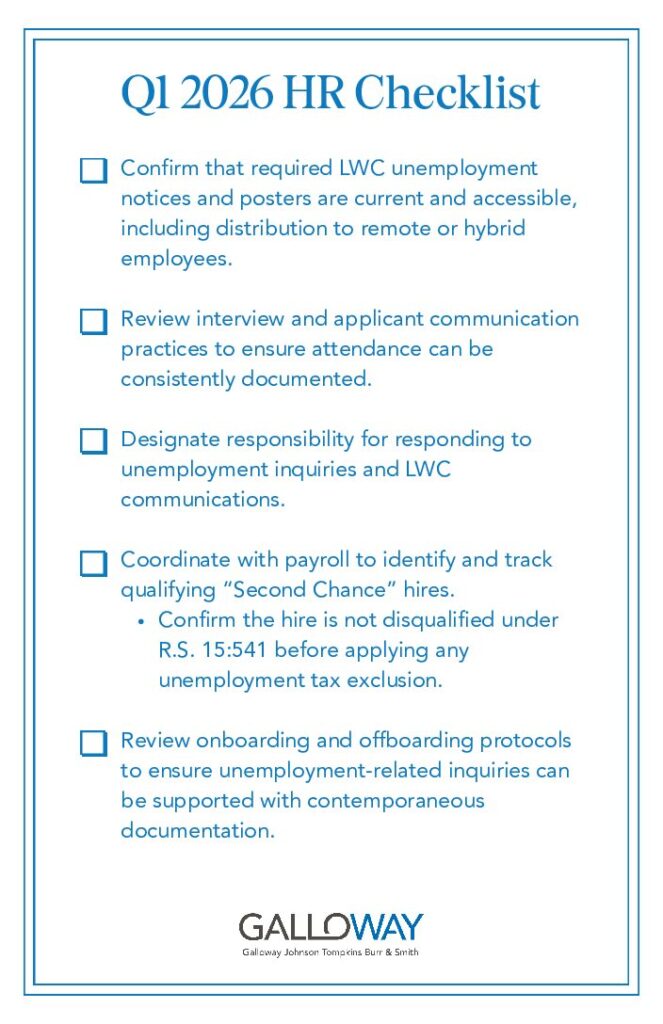
Q1 2026 HR Checklist
- Confirm that required LWC unemployment notices and posters are current and accessible, including distribution to remote or hybrid employees.
- Review interview and applicant communication practices to ensure attendance can be consistently documented.
- Designate responsibility for responding to unemployment inquiries and LWC communications.
- Coordinate with payroll to identify and track qualifying “Second Chance” hires.
- Confirm the hire is not disqualified under R.S. 15:541 before applying any unemployment tax exclusion.
- Review onboarding and offboarding protocols to ensure unemployment-related inquiries can be supported with contemporaneous documentation.
Takeaway for Employers
While these laws do not impose new direct obligations on employers, they expand employer involvement in unemployment administration and offer targeted cost considerations in hiring. An early review of HR procedures and internal coordination can help reduce risk and promote consistent application throughout 2026.
Disclaimer: This material is provided for informational purposes only. It is not intended to constitute legal advice, not does it create a client-lawyer relationship between Galloway and any recipient. Recipients should consult with counsel before taking any action based on the information contained within this material. This material may be considered attorney advertising in some jurisdictions.