On April 6, 2026, the Equal Employment Opportunity Commission (EEOC) released its combined FY 2025 Agency Performance Report and FY 2027 Performance Plan, alongside the Office of General Counsel’s FY 2025 Annual Report. These reports detail a historic year characterized by a leaner, more ideologically focused agency that is successfully utilizing pre-litigation tools to secure record financial outcomes. Most notably, the agency secured almost $660 million for alleged victims of discrimination—its third-highest annual recovery—despite a significant reduction in staffing and a 10% decrease in its budget request for 2026. Read the full report on the agency’s website.
Under the leadership of Chair Andrea Lucas, the Commission has organized its 2026-2027 agenda around “four pillars” of enforcement. These pillars reflect a strategic shift toward what the Chair has characterized as a “merit-based” enforcement model, focusing on individual rights and a move away from identity-based preferences.
Record Settlements and the Role of AI
The EEOC is leaning heavily into its administrative phase to secure funds without ever filing a complaint in court. In FY 2025, the EEOC secured a record $528 million through mediation, conciliation, and settlements—the highest pre-litigation recovery in its 60-year history. The success rate of conciliations has significantly increased, with a 24% jump in monetary recoveries in just one year.
By modernizing its intake system in June 2025 and using AI-driven texting and virtual assistants to communicate with potential claimants, the agency is accelerating investigation timelines to achieve quicker resolution of charges.
The Systemic Approach
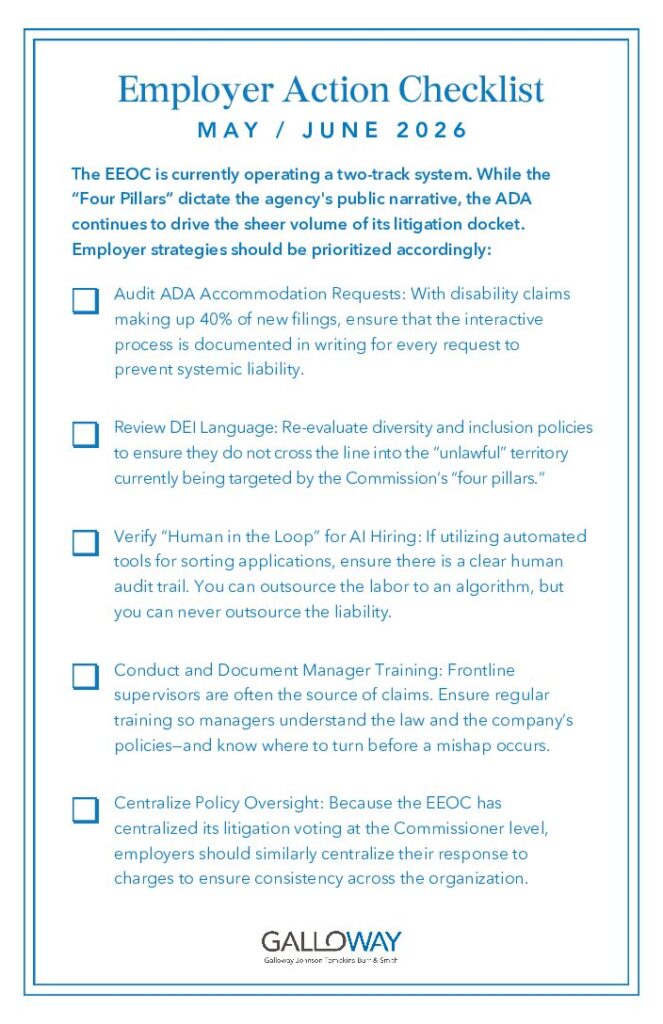
The EEOC is shifting away from high volumes of individual charges in favor of systemic investigations that target company-wide policies. The financial impact of these investigations more than doubled last year (up 115%), as the agency prioritized cases that can extract massive settlements despite a leaner $455 million operating budget.
Key 2026 Legal Battlegrounds
- DEI Scrutiny: Rooting out race and sex discrimination in DEI programs is a top priority. A notable win in FY 2025 included securing settlements and commitments to merit-based employment practices from six of the nation’s largest law firms.
- Anti-American Bias: This priority targets “foreign-preference” national origin discrimination. The report highlights a $1.4 million settlement against LeoPalace Resort for providing less favorable wages and conditions to non-Japanese employees (including American nationals) compared to foreign workers.
- Religious Liberty: The agency has aggressively expanded its focus on religious accommodations, with religious discrimination lawsuits tripling in FY 2025. The report cites $22.8 million in recoveries for religious-based matters since January 2025.
- Biological Sex-Based Rights: Emphasizing “biological truth” in the workplace, this focus includes sexual harassment and the Pregnant Workers Fairness Act (PWFA), notably coinciding with the Commission’s January 2026 vote to rescind previous guidance on gender identity in favor of biological sex protections.
- Disability (ADA) Claims Remain High: According to the Office of General Counsel’s latest enforcement statistics, ADA cases now account for 40% of all EEOC filings in early 2026. This marks a significant increase from 31% in the first half of the previous fiscal year.
Centralized Control
A critical change in early 2026 is that EEOC Commissioners now vote on whether to initiate most litigation, rather than leaving the decision to regional field offices. This move ensures the agency’s litigation agenda is strictly aligned with the administration’s new priorities.
Key Takeaways
The EEOC’s shift toward a “merit-based” enforcement model has resulted in record-breaking financial recoveries, despite a leaner agency structure. By prioritizing systemic investigations and leveraging AI-driven intake tools, the Commission is accelerating the timeline from charge to settlement. For employers and employment law attorneys, the “tea leaves” indicate that the current administration is utilizing its administrative phase to exert maximum financial pressure before litigation.
Disclaimer: This material is provided for informational purposes only. It is not intended to constitute legal advice, nor does it create a client-lawyer relationship between Galloway and any recipient. Recipients should consult with counsel before taking any action based on the information contained within this material. This material may be considered attorney advertising in some jurisdictions.