
The Equal Employment Opportunity Commission (EEOC) has fundamentally shifted its regulatory and enforcement framework with the release of its new Strategic Enforcement Plan (SEP) for Fiscal Years 2025–2029, which focuses on individual merit and intentional discrimination.
Employment law attorneys maintain a high-level understanding of federal anti-discrimination laws, federal agency priorities, and the steps necessary to take upon receipt of an EEOC charge. Employers and business owners can benefit from understanding how the process works so they can meet expectations, prevent claims, and be ready to respond effectively if one arises.
Laws Enforced by the Equal Employment Opportunity Commission
Employers should understand the scope and statutory thresholds of each key federal statute. This is particularly critical for small but growing employers.
| Law | Protected Classes and Coverage | Covered Employers |
| Title VII of the Civil Rights Act of 1964 (Title VII) | Prohibits discrimination, harassment, and retaliation based on race, color, religion, sex (including pregnancy, sexual orientation, and gender identity), and national origin | 15 or more employees |
| The Americans with Disabilities Act (ADA) | Prohibits discrimination against qualified individuals with disabilities and requires employers to provide reasonable accommodations unless doing so causes undue hardship | 15 or more employees |
| The Pregnant Workers Fairness Act (PWFA) | Requires covered employers to provide reasonable accommodations to a worker’s known limitations related to pregnancy, childbirth, or related medical conditions, unless it imposes an undue hardship | 15 or more employees |
| The Age Discrimination in Employment Act of 1967 (ADEA) | Prohibits employment discrimination against individuals who are 40 years of age or older | 20 or more employees |
| The Equal Pay Act of 1963 (EPA) | Prohibits sex-based wage discrimination between men and women performing substantially equal work in the same establishment | Applies to employers engaged in interstate commerce (effectively covering virtually all employers). |
EEOC Priorities for 2026
The EEOC’s new SEP has pivoted away from systemic “disparate impact” claims (neutral policies that unintentionally affect groups disproportionately) to focus almost exclusively on disparate treatment (intentional discrimination).
Furthermore, in June 2026, in a potentially transformative policy shift, the Department of Justice’s Office of Legal Counsel (OLC) issued a formal opinion concluding that the EEOC’s long-standing guidelines on disparate impact liability are unconstitutional.
Following this directive, the EEOC is ending investigations and federal enforcement actions rooted in traditional disparate impact theories.
Warning for Employers: While this opinion freezes government-backed disparate impact enforcement, private plaintiffs may still bring these claims in federal and state courts. Employers likely welcome the reduced federal enforcement risk but should maintain well-documented, defensible hiring standards to guard against private litigation.
As employers audit their policies, bear in mind that the EEOC is aggressively targeting these four areas:
- DEI Initiative Scrutiny: The EEOC is actively investigating and litigating programs labeled or framed as “Diversity, Equity, and Inclusion” if they result in employment decisions based on race or sex. Legally suspect practices include race- or sex-based quotas (even if framed as goals), “diverse slate” hiring mandates, diversity statements required of candidates, and tying executive bonuses directly to demographic metrics.
- Protection of American Workers: The EEOC is targeting national origin discrimination that favors foreign visa holders (such as H-1B or guest-worker programs) over qualified American citizens.
- Religious Liberty and Sex-Binary Rights: Following recent Supreme Court developments, the EEOC is scrutinizing failures to provide religious accommodations. Concurrently, the agency is addressing high-profile issues involving the preservation of single-sex intimate spaces (restrooms/locker rooms) and an employee’s right to express the binary nature of biological sex. See Groff v. DeJoy, 600 U.S. 447 (2023)
- The Muldrow “Some Harm” Standard: Following the Supreme Court’s ruling in Muldrow v. City of St. Louis, an employee no longer needs to prove a “significant” employment disadvantage (like a demotion or pay cut) to claim discrimination; showing “some harm” regarding a transfer, shift change, or lateral move is now sufficient to support a charge. See Muldrow v. City of St. Louis, 601 U.S. 346 (2024).
What to Expect – The Anatomy of an EEOC Charge
An EEOC Charge is a formal, signed statement by an employee or applicant alleging that an employer engaged in unlawful discrimination. The official notice typically arrives as an EEOC Form 5 (Charge of Discrimination). This form contains the name and personal details of the employee, the legal name and contact information of the employer, and the worker’s estimate of the employer’s headcount.
On the Form 5, the charging party specifies the exact statutory basis of the claim (e.g., race, sex, disability, age, or retaliation) along with the earliest and latest dates when the alleged discrimination occurred. The employee also provides a narrative detailing their factual allegations, timeline, and the key decision-makers involved.
The Administrative Timeline
- Filing Deadline: The worker must generally file a charge within 180 days of the alleged discriminatory act. This window is extended to 300 days if the charge is dual-filed with a state or local Fair Employment Practices Agency (FEPA).
- Notice to Employer: The EEOC must send a notice of the charge to the employer within 10 days of filing.
- Administrative Exhaustion: For claims under Title VII, the ADA, and the PWFA, an employee generally cannot sue an employer in court without first filing a charge with the EEOC and receiving a “Right-to-Sue” letter. Under the ADEA (Age Discrimination), they must also file an EEOC charge but can head straight to court 60 days after filing, even without a letter. While administrative exhaustion is a mandatory step for these laws, certain other federal claims (most notably under the Equal Pay Act and Section 1981) allow employees to bypass the EEOC entirely and go directly to court.
- EEOC Determination and Timelines: If the EEOC chooses not to file a lawsuit itself, it will issue a Notice of Right to Sue. Additionally, an employee can generally request this notice if the EEOC has not completed its investigation within 180 days of filing. Once the Notice of Right to Sue is received, the employee then has a strict 90-day window to file a lawsuit in either state or federal court.
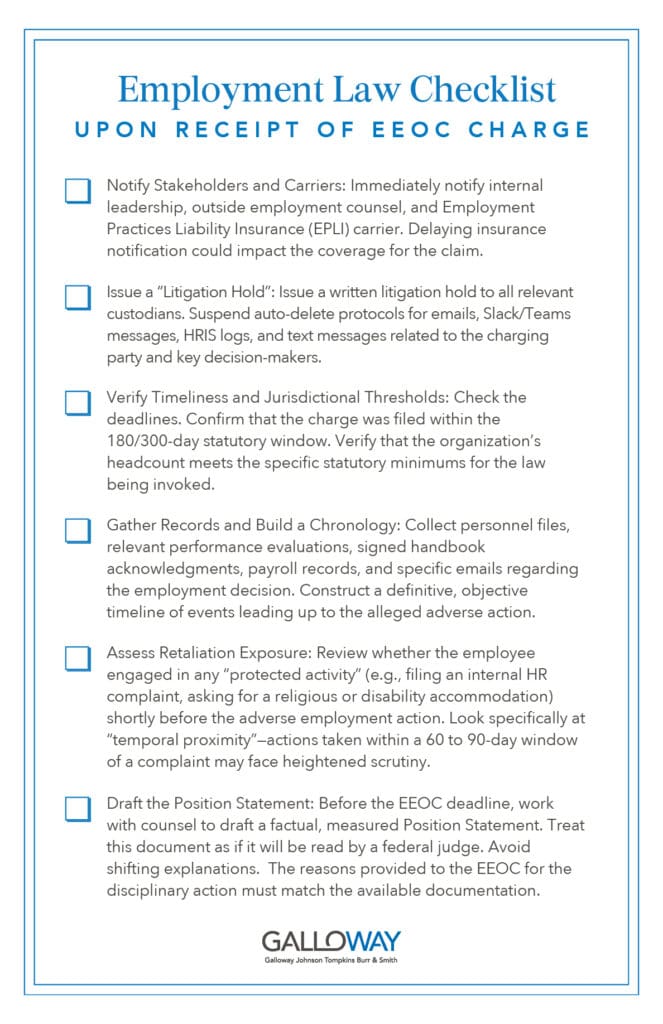
Employer Checklist – What to Do Upon Receipt of a Charge
When an EEOC charge hits your desk, the clock begins ticking immediately. Use this checklist to organize the process:
Retaliation Warning
Statistically, retaliation remains the most common claim filed with the EEOC. Even if the underlying discrimination claim is entirely meritless, an employer can still be liable if it treats an employee adversely because they complained or filed a charge.
State and Local Variances to Keep in Mind
Federal law acts as a legal floor, not a ceiling. State and municipal laws frequently expand these protections:
- Alabama, Georgia, Louisiana & Mississippi: Generally align with federal thresholds. Alabama, Georgia, and Mississippi lack comprehensive state anti-discrimination agencies, defaulting entirely to federal EEOC procedures. Louisiana matches the federal baseline closely but requires careful navigation of its unique state-level pre-suit notice requirements.
- Florida & Texas: Maintain robust state workforce commissions with explicit filing rules that can expand local liability.
- Missouri (and City of St. Louis): Maintain strict municipal or state-level ordinances regarding protected classes and local scheduling/wage compliance that frequently exceed the federal baseline.
Disclaimer: This material is provided for informational purposes only. It is not intended to constitute legal advice, nor does it create a client-lawyer relationship between Galloway and any recipient. Recipients should consult with counsel before taking any action based on the information contained within this material. This material may be considered attorney advertising in some jurisdictions.