
Corporate legal departments continue to monitor the growth and impact of third-party litigation funding (TPLF). As funding models evolve and disclosure norms remain unsettled, in-house counsel face mounting questions about risk, effective strategies, legal system drivers, trends, and governance. We will examine core concepts, common concerns, and actionable steps that legal teams in the Gulf South and Midwest are implementing to counteract TPLF.
What is TPLF and Why It Matters
Third-party litigation funding is a multibillion-dollar global industry that provides capital to claimants or law firms in exchange for a portion of any recovery. Unfortunately for defendants, the market is largely unregulated, making it difficult for parties and courts to comprehend who is influencing litigations decisions.
Funding can prolong the lifecycle of a case, increase defense costs, and complicate settlement dynamics when funders target higher return on their investment rather than mutually acceptable resolutions.
Key Concerns for Corporate Legal Teams
- Transparency and control: Courts and opposing parties are often unaware of funder involvement, which can blur who is truly steering litigation strategy and settlement posture.
- Settlement friction and nuclear verdicts: Funding could incentivize higher demands and prolonged disputes, and has been linked to inflated verdicts in some venues, further inflating risk.
- Consumer lending practices: In the consumer context, lawsuit lending can be accompanied by steep rates and fees, raising ethical concerns that may arise during discovery and motion practice.
- Foreign capital risk: Practitioners have flagged the potential for foreign investors – including sovereign wealth funds – to use TPLF to access sensitive information or influence outcomes, a concern highlighted by limited visibility into funding sources.
An Offshoot to Monitor: Third-Party Medical Funding (TPMF)
In some personal injury matters, separate funders finance medical treatment, place liens at “sticker price,” and seek recovery from settlement. This dynamic brings the possibility of amplifying damages positions while complicating evaluation and negotiation strategies. In a particular way, understanding how liens were structured can be critical in case assessment and discovery planning.
Evolving Litigation Environment
In-house counsel continue to operate in a shifting legal landscape. They face a growing list of challenges: litigation funding, plaintiff-friendly venues, changing rules, and inconsistent standards across jurisdictions. These factors can widen exposure and significantly alter forum and case strategy. In-house legal teams can calibrate risk and prepare witnesses more effectively through a heightened awareness of trial tactics that aim to reframe duties or elevate burdens. Experienced outside counsel monitors and counters juror sentiment trends across jurisdictions.
Actionable Steps for Discovery and Strategy
Though disclosure standards vary, there are structured ways to investigate unseen funding and manage related risks:
- A first step in combating TPLF is bringing visibility and awareness to the financing arrangements at issue. Identifying the funder and terms through early, targeted discovery can reveal whether a funder has a stake and whether exploitive terms are exerting pressure on settlement posture. Sample requests include funding company agreements, contracts, liens, letters of protection, and any instruments giving medical providers a financial incentive in the outcome.
- To mitigate the influence of broad narratives amplified by external capital, focus on the fundamentals in trial strategy early. Emphasize case-specific facts and applicable standards of care, consider motions in limine, and implement clear them from opening through closing.
- Proactively plan for common tactics used by plaintiffs’ counsel. Be consistent in written discovery, meet early with client representatives, and diligently prepare witnesses for “Reptile Theory” style questioning themed on community safety. Practical planning, from mock Q&A to documenting safety procedures can defuse overbroad arguments and keep the focus on adjudicable facts.
- Saturated legal advertising and social media may shape juror expectations. By monitoring advertising and jury-pool effects, teams consider this context in venue assessment, voir dire planning, and damages projections.
Policy Trends
Support for disclosure requirements is growing, requirements that would bring TPLF arrangements to light and clarify the competing interests driving litigation outcomes. For corporate defendants and insurers, a transparent structure could rebalance negotiations and facilitate smoother resolution when applicable. Until such time when meaningful procedures are in place, internal protocols can assist legal departments in standardizing how they identify and escalate TPLF considerations across high-value and complex matters.
Regional Considerations for the Gulf South and Midwest
Jurisdictional differences remain significant, and venue-specific practices can influence outcomes. Counsel in Texas, Louisiana, Mississippi, Alabama, Florida, Georgia, and Missouri can stay current on local developments that affect discovery into funding arrangements, admissibility, and motion practice. Adapting strategies to the specific forum is essential, particularly in regards to jury-pool dynamics, venue rules, and punitive-damages frameworks.
Experienced Legal Teams Face Third-Party Litigation Funding
Seasoned defense perspective can streamline early case assessment: identifying signs of TPLF, tailoring discovery to surface funding terms, preparing corporate representatives to navigate plaintiff-friendly narratives, and structuring motions that keep trials focused on the applicable standard of care. Defense attorneys at Galloway Johnson Tompkins Burr & Smith regularly advise corporate clients on these challenges, and integrate funding-cognizant strategy into broader litigation plans, from venue selection to settlement positioning.
Key Takeaways for In-House Counsel
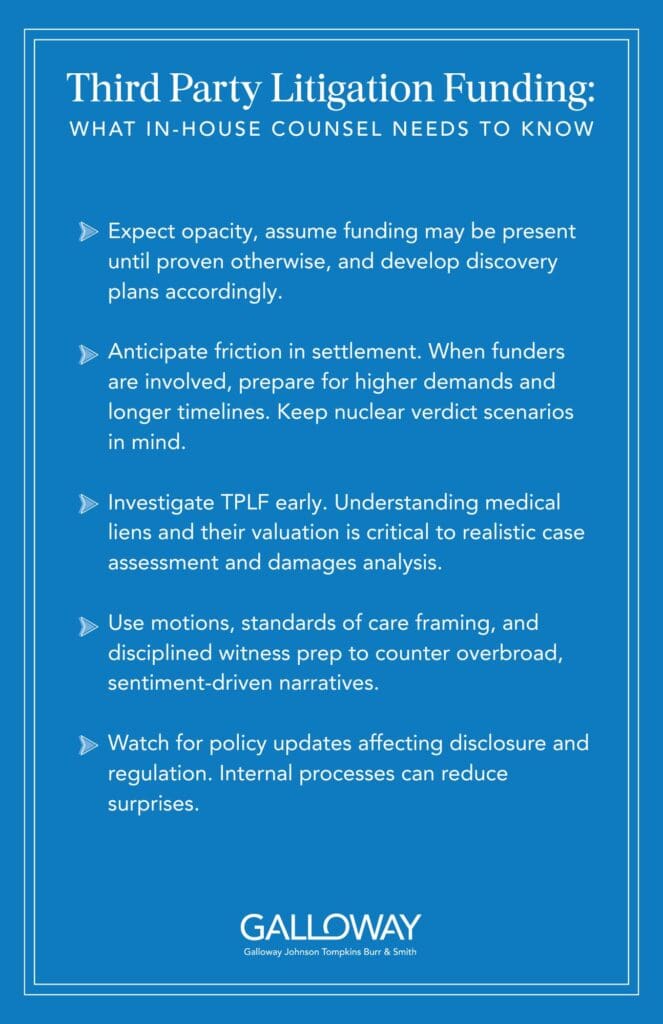
- Expect opacity, assume funding may be present until proven otherwise, and develop discovery plans accordingly.
- Anticipate friction in settlement. When funders are involved, prepare for higher demands and longer timelines. Keep nuclear verdict scenarios in mind.
- Investigate TPLF early. Understanding medical liens and their valuation is critical to realistic case assessment and damages analysis.
- Use motions, standards of care framing, and disciplined witness prep to counter overbroad, sentiment-driven narratives.
- Watch for policy updates affecting disclosure and regulation. Internal processes can reduce surprises.
Disclaimer: This material is provided for informational purposes only. It is not intended to constitute legal advice, nor does it create a client-lawyer relationship between Galloway and any recipient. Recipients should consult with counsel before taking any actions based on the information contained within this material. This material may be considered attorney advertising in some jurisdictions.