
In the first hours after a suspected cyber breach, treat the incident as a legal and insurance event: escalate to counsel, contain and investigate, preserve evidence, trigger cyber‑insurance notice, and plan regulator/consumer communications on jurisdiction‑specific timelines to avoid lost coverage and enforcement risk. Establishing vendor relationships pre-beach can assist in utilizing vetted, trusted, and reputable assistance post-breach without delay.
A breach response that is fast, led by experienced cyber counsel, and insurance‑aligned protects the enterprise in two ways, by meeting regulatory deadlines and by preserving coverage under strict policy conditions. Outside counsel can typically coordinate notice, forensics, vendor engagement, and deadlines; while missteps can compromise coverage, and the notification “clock” can run quickly under federal and state regulations, especially when personal or health data is involved.
What to Do Next
The first crucial decisions after a cyber event are legal, regulatory, and insurance decisions as much as they are technical. Structured response, preservation of privilege, effective forensic analysis, and r cyber‑insurance notice to protect coverage are among the first steps following a breach. Regulators and contracts may impose strict, fast-moving notification requirements, making pre-breach knowledge of such requirements important.
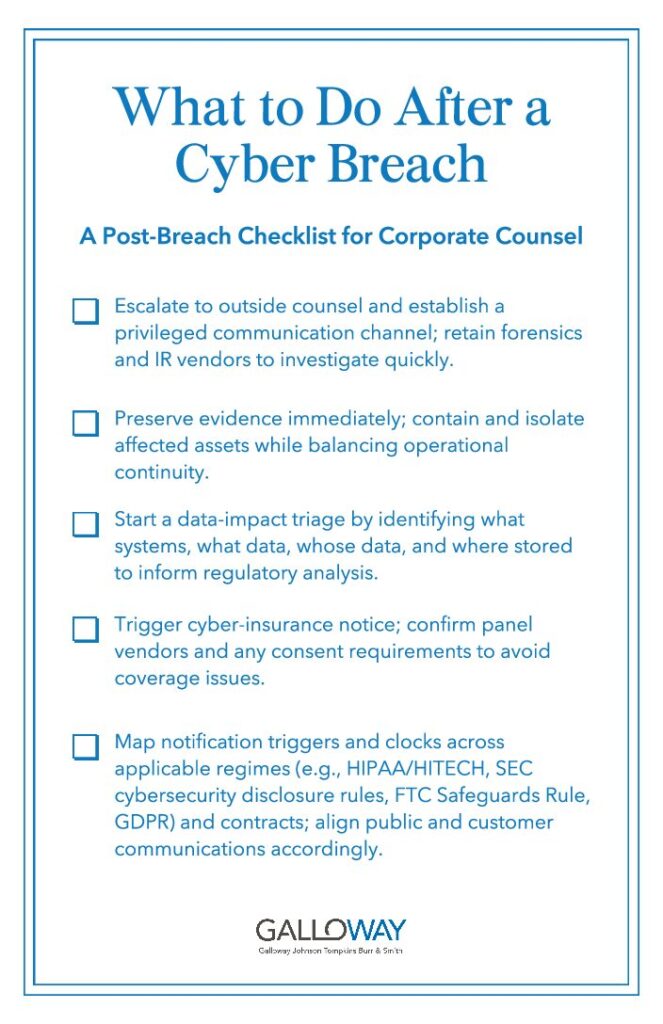
Post-Breach Checklist
- Escalate to outside counsel and establish a privileged communication channel; retain forensics and IR vendors to investigate quickly.
- Preserve evidence immediately; contain and isolate affected assets while balancing operational continuity.
- Start a data‑impact triage by identifying what systems, what data, whose data, and where stored to inform regulatory analysis.
- Trigger cyber‑insurance notice; confirm panel vendors and any consent requirements to avoid coverage issues.
- Map notification triggers and clocks across applicable regimes (e.g., HIPAA/HITECH, SEC cybersecurity disclosure rules, FTC Safeguards Rule, GDPR) and contracts; align public and customer communications accordingly.
Breach Impact on Business Operations
Cyber incidents are enterprise risks that implicate financial integrity, compliance posture, and client trust. Both courts and carriers examine whether the organization acted reasonably and followed its own protocols. Cross-functional readiness and disciplined post-breach execution materially influence litigation exposure and insurance recovery.
In litigation and regulatory reviews, the questions are predictable: were appropriate policies in place? Were they followed? Were employees trained? Were warnings ignored? Assistance from counsel can be utilized to close those gaps pre-breach and to operationalize legal requirements across business teams before and after an incident.
Key Takeaways
- The notification clock can run fast; build your structure before it is needed.
- Establish vendor relationships pre-breach to avoid post-breach delay in vetting qualified and reputable assistance.
- Insurance recovery is not automatic—meet notice/consent requirements and mind exclusions.
- Courts and carriers evaluate reasonableness and protocol adherence; training and documentation matter.
- Counsel‑led notice and effective vendor forensics protect the investigation and streamline post-breach efficiency.
Disclaimer: This material is provided for informational purposes only. It is not intended to constitute legal advice, nor does it create a client-lawyer relationship between Galloway and any recipient. Recipients should consult with counsel before taking any actions based on the information contained within this material. This material may be considered attorney advertising in some jurisdictions.